Rat Dissection - Urogenital System


The excretory and reproductive systems of vertebrates are closely integrated and are usually studied together as the urogenital system. However, they do have different functions: the excretory system removes wastes and the reproductive system produces gametes (sperm & eggs) and provides an environment for the developing embryo.
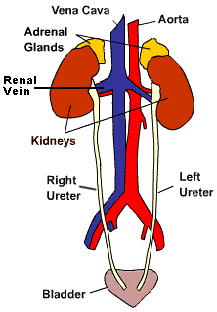
Excretory Organs
1. The primary organs of
the excretory system are the kidneys. Locate these large bean shaped
structures located toward the back of the abdominal cavity on either side of
the spine. Renal arteries and veins supply the kidneys with blood. 
Trace these vessels to where they connect to the aorta and vena cava (two large vessels of the abdominal cavity)
2. Locate the delicate ureters
that attach to the kidney and lead to the bladder. Wiggle the kidneys to help
locate these tiny tubes.
3.  Procedure:
Remove a single kidney (without damaging the other organs) and dissect it by
cutting it longitudinally. Locate the cortex (the outer area) and the
medulla (the inner area).
Procedure:
Remove a single kidney (without damaging the other organs) and dissect it by
cutting it longitudinally. Locate the cortex (the outer area) and the
medulla (the inner area).
4. The urethra carries
urine from the bladder to the urethral orifice (this orifice is found
in different areas depending on whether you have a male or female rat).
5. The small yellowish glands
embedded in the fat atop the kidneys are the adrenal glands.
**You are responsible for knowing the structures of both sexes. Locate the structures in your own rat and then observe the structures of the opposite sex from another group's rat.
The Reproductive Organs of the Male Rat
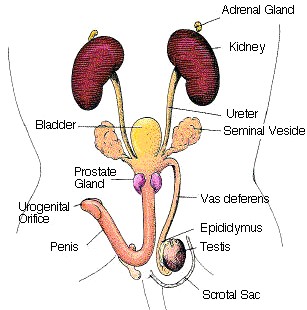
1. The major reproductive
organs of the male rat are the testes (singular: testis) which are located
in the scrotal sac. Cut through the sac carefully to reveal the testis.
On the surface of the testis is a coiled tube called the epididymus,
which collects and stores sperm cells. The tubular vas deferens moves
sperm from the epididymus to the urethra, which carries sperm though
the penis and out the body.
2. The lumpy brown glands
located to the left and right of the urinary bladder are the seminal vesicles.
The gland below the bladder is the prostate gland and it is partially
wrapped around the penis. The seminal vesicles and the prostate gland secrete
materials that form the seminal fluid (semen).
The Reproductive Organs of the Female Rat
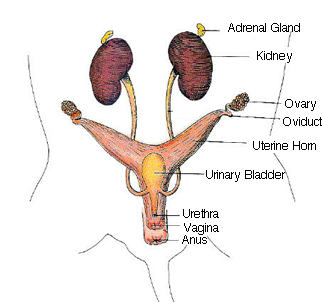
1. The short gray tube lying
dorsal to the urinary bladder is the vagina. The vagina divides into
two uterine horns that extend toward the kidneys. This duplex uterus
is common in some animals and will accommodate multiple embryos (a litter). In
contrast, a simple uterus, like the kind found in humans has a single chamber
for the development of a single embryo.
2. At the tips of the uterine
horns are small lumpy glands called ovaries, which are connected to the
uterine horns via oviducts.
Procedure:
Pin the organs of the urogenital system.
Checkpoint and Further Investigation
1.What tube connects the kidney to the bladder?
2. What vessels connect to the kidney?
3. Urine exits through what external opening on both male and female rats?
4. Compare the location of the urethral orifice on male and female rats.
5. What is the function of the excretory system?
6. Why are the kidneys considered major organs responsible for maintaining HOMEOSTASIS? (you may need to look this up.)
7. The word "vasectomy" is derived from the tube known as the vas deferens. What is a vasectomy?
8. How does the anatomy of a female rat differ from that of a human?
Other Resources on the Rat
Rat External Anatomy | Head | Abdominal Cavity
Circulatory System | Urogenital System
Other Resources:| Virtual Rat Dissection | Rat Dissection with Photo Submission